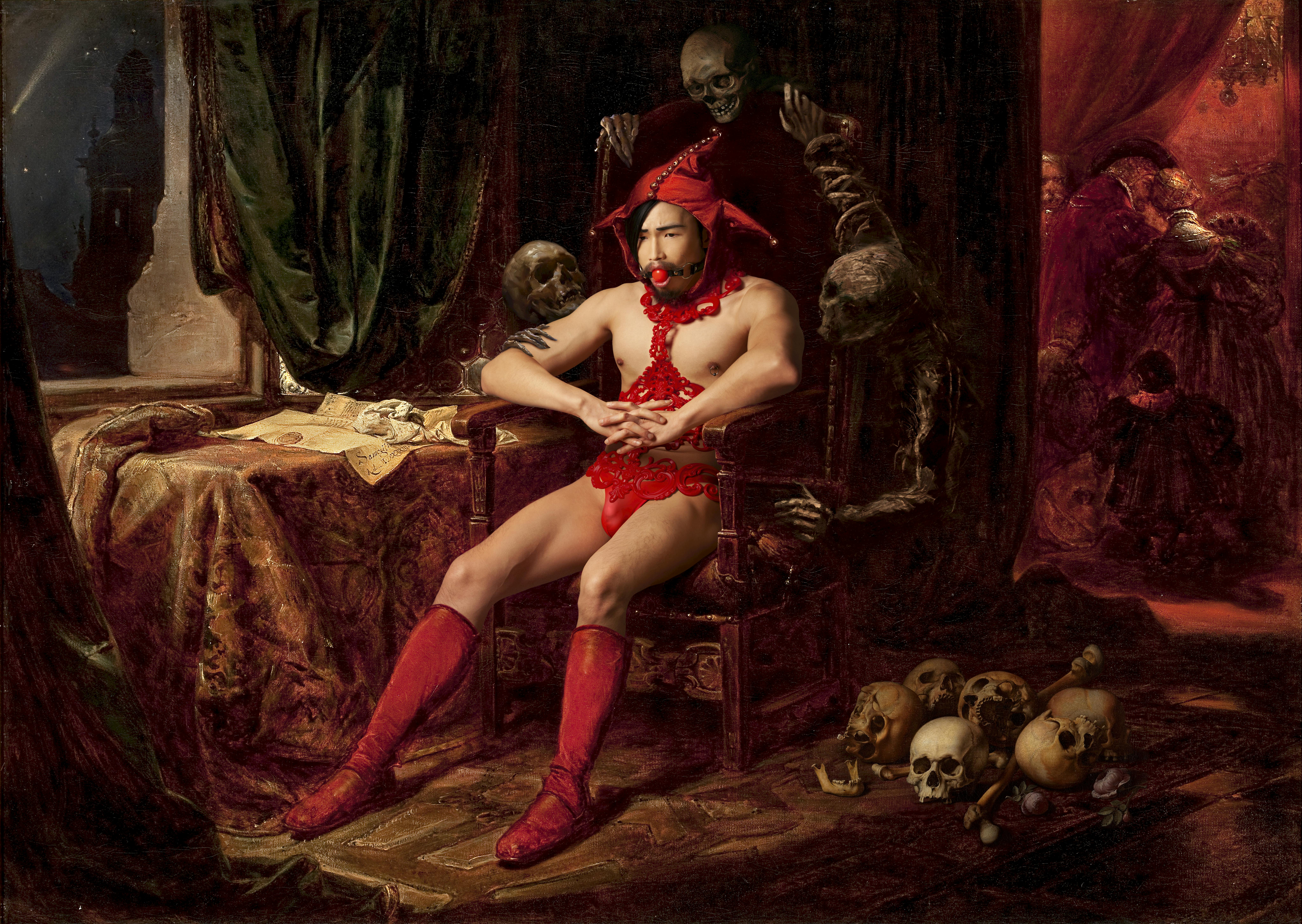
The American Dream - “America’s greatest export” according to Chris Gardner, author of the best-selling autobiography “Pursuit of Happyness”. “The very idea that you can be anything you imagine”. Known across the globe as a synonym of capitalistic values, the American Dream has grown to be bigger than America itself. It has become a symbolic term to describe resilience and determination that often glosses over the sacrifices it entails. In titling my work after the well-known phrase, I aim to offer a critical and satyrical perspective on our modern societal influences and cultural standards. Attempting to visualize it from the perspective of an outsider navigating the era of extreme self-indulgence and mass media consumption.
This work builds upon Rudolf Friedrich August Henneber’s painting, “The Pursuit of Happiness” (1863-1868), ironically titled and that can offer some commentary on the topic. When do our dreams become obsessions? How do we escape the endless effort to satisfy needs without ever reaching satisfaction? Henneberg’s work could not offer me a better playground to indulge in the topic of greed. Strong composition with a natural flow, an ever-unreached fortune on the left, the death co-riding the horse, the bubble (!); I knew I had to do it and I knew I had to go a step further. To find a way to fully depict the transition, to illustrate a living experience in the shadow of expectations. As my work often does, I once more placed a lot of attention on the role of attractiveness and beauty standards within social and cultural contexts. Having to juxtapose past and present, I sometimes oversee how our societies have transitioned from simplified, geographically-limited sociocultural influences to increasingly universal ones existing in the online sphere. Whether located in Asia, Europe, Africa, or America, most individuals establish similar idealized versions of themselves shaped inside the contexts of globalization and mass media consumption.
Through this work, I decided to explore the topic of greed not just in terms of material needs but as an increasingly artificial influence on our desire to present ourselves in a way that adds superficial social value. The caricature of myself on the left side of the composition acts as a reminder of the unrealistic social pressure we inflict upon ourselves, to represent the pursuit of false happiness, and to emphasize how illusions could never truly fulfill us.