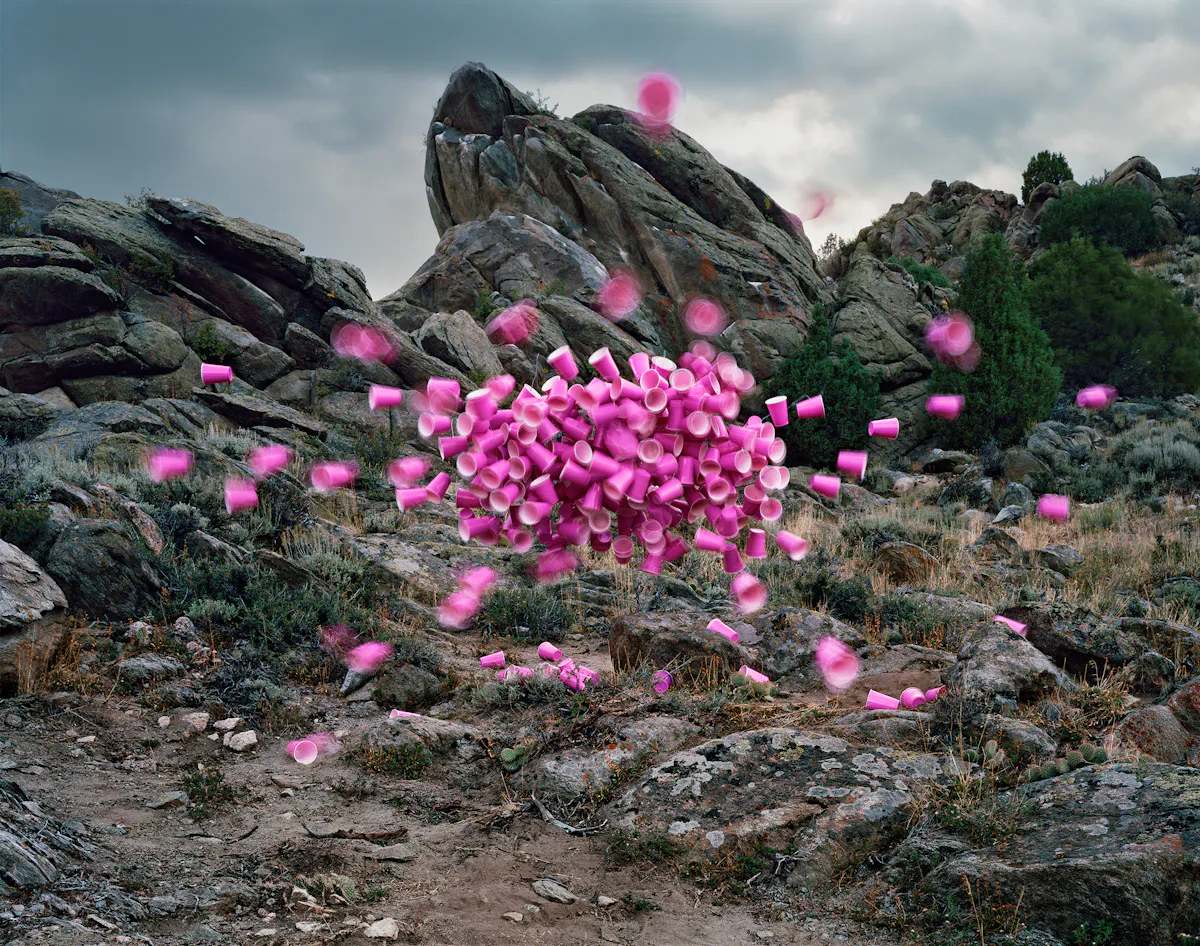
Looking back now, I see 2020 as a year of adaptation. As painful as the COVID lockdowns were, they created a powerful incentive to simplify, and to come up with ways to do more with fewer resources. They also gave us plenty of time to think about the escalating environmental consequences of our profligate habits, among them wildfires, hurricanes and global pandemics. For me personally, 2020 was proof of the adage that creativity thrives under constraints. Unable to travel, for instance, I visited the same local locations again and again, finding new dimension in familiar landscapes. And rather than skipping from one sculptural object to another, I focused on a single material all year, nylon tulle. I chose tulle for its mutability—depending on how it’s arranged and how the wind catches it, it can morph from a solid to a liquid, to fire to billowing smoke. Above all, 2020 was the year I tried to harness the wind. On every shoot, Northern California’s offshore breezes were my collaborator, the force that transformed my installations from lifeless fabric to living things. As collaborations go it was a tumultuous one—of the twenty or so pieces I built and photographed in 2020, thirteen were failures. But the exceptions like this one, shot in the Point Reyes National Seashore, made the effort worthwhile.



 rudyavault