


Full Size
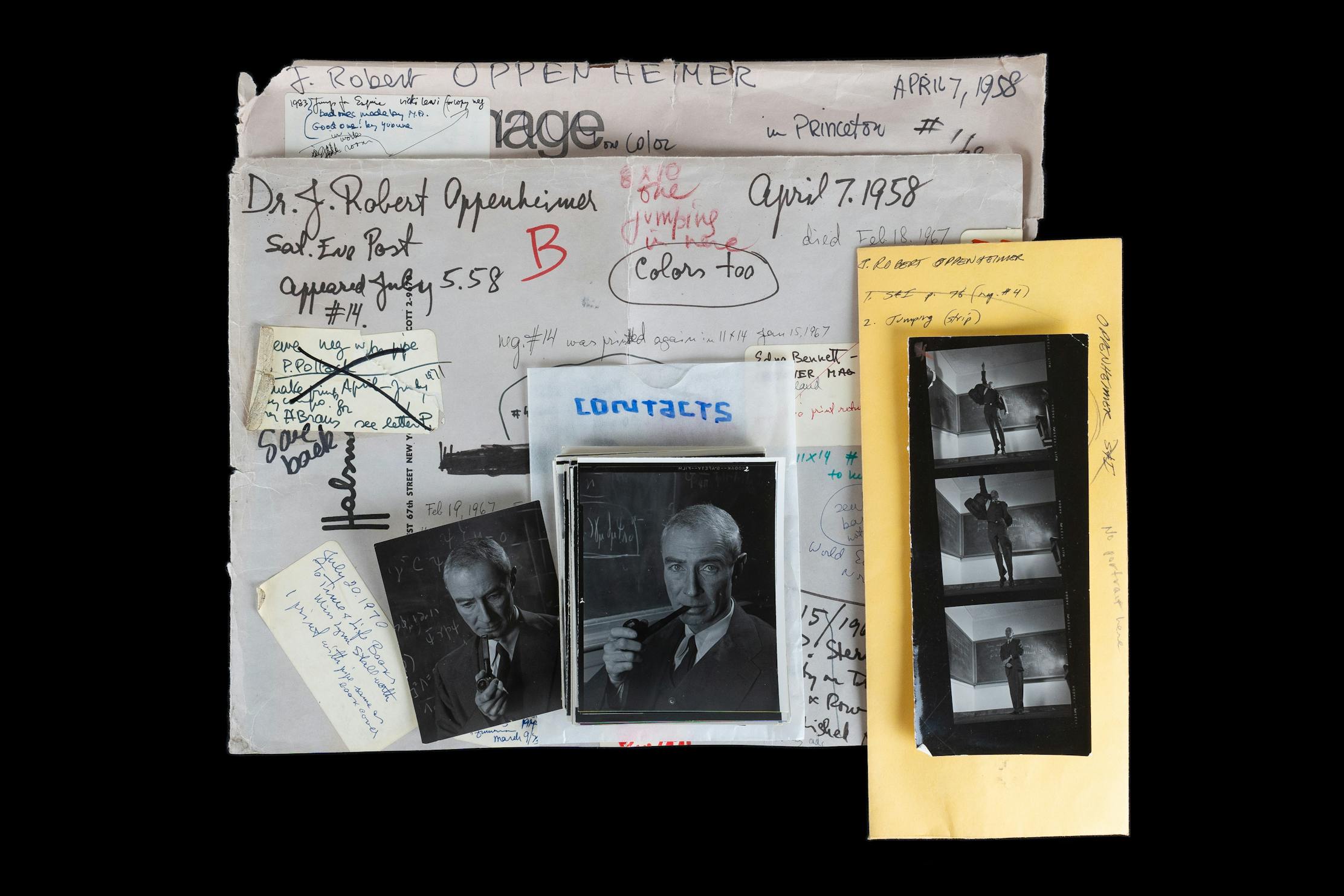
Halsman Archive File 20 -J. Robert Oppenheimer 1958
Oppenheimer was a genius. Before WWII he had studied at Harvard and Cambridge and held teaching positions at UC Berkeley and Caltech, focusing on nuclear physics and quantum mechanics. As the world slipped into war, scientists who escaped from Nazi Germany spoke of successful research in splitting the atom, which released energy. Scientists realized that this power in the hands of the Nazis was so dangerous that the USA needed to get the brightest minds together and develop a weapon before the Nazis could. Oppenheimer was recruited to lead The Manhattan Project’s secret Los Alamos Laboratory. After a few years they had successfully developed a working atomic bomb, but by then the Germans had surrendered, and Japan was the last of the Axis powers at war with the USA. In Aug 1945 two Nuclear bombs were dropped on Japan and the war came to an end, and the Nuclear arms race with Russia began. Oppenheimer supported controlling nuclear power to avert nuclear proliferation, but in 1954 he was accused of having communist sympathies and his security clearances were revoked in a public hearing. Four years later Halsman drove to his office at the Institute for Advanced Study in Princeton to photograph him for Saturday Evening Post’s “Adventures of the Mind.” Halsman was sympathetic to his trial and was conflicted as to how to photograph him. Halsman wanted a confrontation with his lens and expressed his indignation regarding the trial. Oppenheimer looked up and Halsman released the shutter, capturing the pain and hurt in his eyes. Halsman also wanted to show him as a thinker, not just as a victim, and photographed him slightly above, accentuating the size of his head and intelligence. As Oppenheimer ended the shooting he suggested that Halsman should decide on one pose ahead of time and make one exposure, instead of spending time trying and searching. Halsman was stunned by the suggestion in the moment, which made him question his whole approach at photographing a moment of emotional truth. Halsman wondered if Oppenheimer was right or if he was just being arrogant. Later Halsman realized Oppenheimer was right, if one were photographing a statue. The photos Halsman took immortalized Oppenheimer on book covers and in the article in LIFE Magazine announcing his death in 1967.
- MediumImage (JPEG)
- File Size4.4 MB
- Dimensions4368 x 2912
- Contract Address
- Token StandardERC-721
- BlockchainEthereum


