

- Editorial
MoCDA Interview with Gordon
Editorial is open for submissions: editorial@superrare.com
Gordon Berger: Pioneer of the NFT/Crypto Art movement, multidisciplinary artist and the first TEDx speaker about blockchain and art in early 2018. In conversation with Serena Tabacchi about his creative journey.In the studio with Gordon Berger: a dive trhough the art of one of the most inspiring artist from the digital art scene. By blending cutting edge technologies and more traditional painting techniques, Gordon creates unique art trough the adoption of blockchain technology.
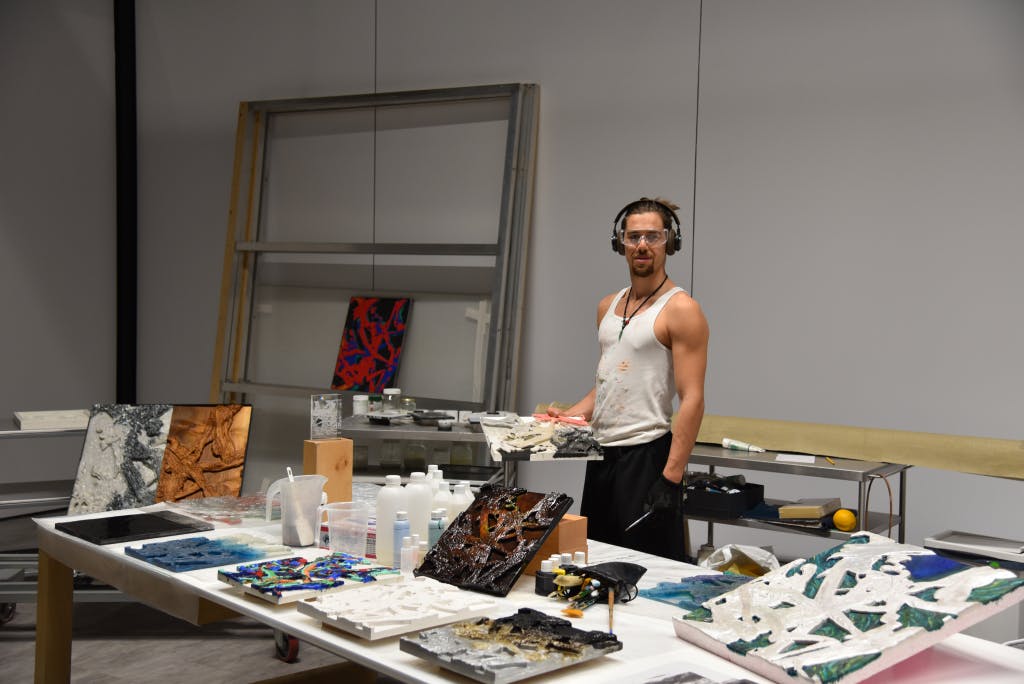
Q: Gordon, in your art there are both human and technical components that are in collaboration during the creation of the final artworks. How do you experience this relationship as an artist?
A: My practice usually addresses painting in relation to the impact of technology. I find it very exciting to explore the intersection between the virtual word and our physical reality. It’s so interesting how those boundaries become more and more blurry in our lives. I’m developing my practice in this ‘grey’ area which reflects the condition of our mixed reality.
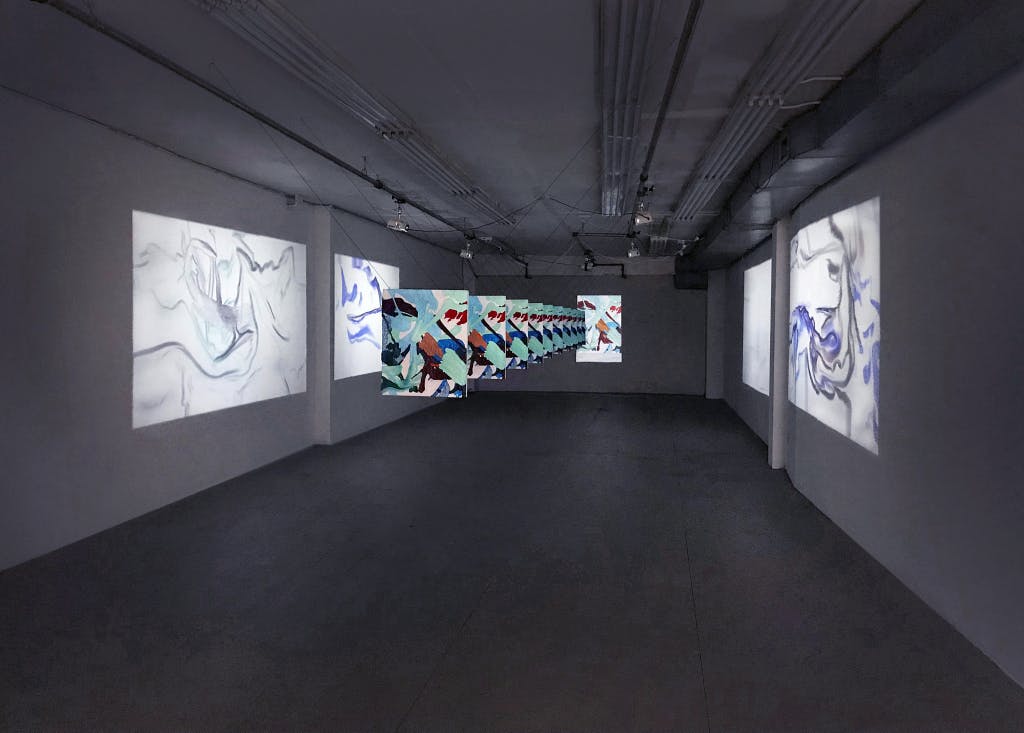
Q: Do you think machines can be creative?
A: I don’t think a machine is truly creative, it only has a system which is completely programmed by a human. It takes certain input to perform some mathematical functions and then generates an output. The foundation for creativity is consciousness. The ability to make new connections and draw conclusions from experiences, knowledge and memories is something that is unique to humans and machines currently lack that.(‘Blue Ocean’, Digital Painting Series, 2020, NFT by Gordon Berger)
Q: You were the first TEDx speaker to talk about Crypto Art and NFTs in early 2018. What do you think about it now and what is the additional value of working with blockchain technology?
A: It is interesting to think about what will be written in 200 years in history books about this 2010’s and 2020’s period. What actually makes this time unique? I think blockchain and NFTs are some of those things that are and will continue transforming society and the digital dimension.
In relation to digital art, it is a paradigm shift, because it introduces a new perspective and a way of disseminating artworks. It also solves some important issues regarding ownership, authenticity and decentralization. This technology directly inspired the two latest series that I did, “Solidity” and “Materiality”.
Q: In those artwork series are you always pleased with the result produced by the algorithms you use?
A: The process begins by uploading my singular brushstrokes to the algorithm, so my individual freedom is expressed in those gestures. Afterwards the algorithm combines those brushstrokes and creates a painting. Since I have no control over it, it is natural that I don’t like every result. However, this part of the process I consider a collaboration with the algorithm. Where in the end I choose which abstraction I am going to pursue in the series.
Q: Have you ever questioned the aesthetic outcome from your collaboration with technology?
A: In these artwork series the first part of the process, where the abstraction is generated, is not really about the aesthetics. It is mostly about letting go of the control and the action of outsourcing this part of creation to the blockchain algorithm.
Q: From the creative side, is there anything you believe blockchain is adding to your work?
A: It inspired me to question our perception of value as it relates to physical and digital objects. Regarding my immaterial art, blockchain shaped a whole new virtual dimension where digital art can live with a community of people who appreciate it.
However, in the case of ‘Solidity’ and ‘Materiality’ series, the data from the blockchain literally influences the composition of the digital painting. In this case blockchain directly inspires and impacts the creative process and how the abstract artworks look like.(‘Solidity’ Blockchain Artwork Series, generated digital NFT and the materialized artwork, 2019)
Q: You’re saying that the actual data produced by the blockchain somehow influences and is embedded into the visual outcome?
A: Absolutely because the algorithm is set up in that way. For example, some of the data it uses is: the exact time of creation, block hash and my public key. Which means If I were to generate a painting now or in 20 minutes, it would look totally different because most data parameters would have changed.
Q: This must be the first artwork to actually be digitally created with and on the blockchain and afterwards materialized from the digital to physical reality?
A: Exactly, because the painting is tokenized as it is ‘born’ and then later, I use 3D software to bring it from this virtual crypto dimension into physical reality. Then I create many physical copies in different material combinations, based on the unique digital NFT. (‘Materiality’ Blockchain Artwork Series, Generated NFT artwork and some of the materialized pieces)
Q: Are you emotionally moved by working with blockchain and technology in general?
A: Yes, tech inspired me since I was really young, and I’ve always been curious to learn about it. I love to combine it with physical and digital art techniques. It definitely moves me and I’m really passionate about digital media such as digital painting, because it allows me to create at the same speed as my brain works while browsing the internet or scrolling through social media.
Q: What are some of the main differences you find between physical and digital painting?
A: Traditionally when you use physical painting you must mix the colors and then you must wait a couple of hours for the paint to be dry in order to add a new layer. Digital painting is instantaneous; you can apply a dark colour, then a light colour over it in a matter of seconds. This process allows for speed and creativity. It’s also like having an extra sense of freedom because, in the digital space, you have the undo button which gives you a feeling of courage; you can paint half of the canvas red, click a button, undo it and do something totally different. So, you can paint and take all these risks you probably wouldn’t in physical reality which usually results in making more interesting work.
The digital space has a totally different dynamic from the physical one, and that’s something I find really inspiring and makes me want to explore it further.(Digital painting creation process by Gordon Berger)
Q: When you collaborate with technology, do you see it as somebody helping you out? Or collaborating with someone equal to your creative level? Or do you just see it as a tool that you use to achieve something within your work?
A: It depends but in most cases technology is a tool. If I don’t know how some aspects function, sometimes I imagine there is a technological being that I’m interacting with. But if I know how the code works and what it is meant to do, I feel it’s like being a magician looking at what’s happening from behind the curtain. Once you know how the system works, how it is coded, and what those mathematical equations are and what the potential results will be, then it’s almost like the curtain is pulled away, however the process is still filled with surprises. (‘Digital Materiality’, group exhibition project, 2018, Tate Modern, London)
Q: Somebody could describe your art as abstract, do you agree?
A: I am very interested in it. Abstraction can help us think about technology, its forms and functions. Many concepts we are dealing with on the daily basis are abstract, like: friendship, freedom, markets, religion, currency… so it can help us get a new perspective on the world we live in.
I am currently working on a new series of paintings called ‘Evolve’ where each new painting will be built on top of the previous version. I want to make a series of paintings that is not static but evolves, adapts and updates much like our online world. (‘Evolve 5’, Digital Painting, 2021, NFT by Gordon Berger)
Q: I know you’re very careful about choosing the colours, shapes, and forms, but do they hold meaning to you? Do they represent something? Or do you see it as something that goes beyond the forms?
A: In some cases, it is an expression of emotions and feelings or responses to past experiences. In other cases what inspires the artwork are forms, visuals or scenes experienced online and offline. Which I am translating through my perception onto the canvas. A piece could also be a combination of few concepts, images or even contrasting feelings, that I try to blend in order to create that abstraction.
All of these experiences can be seen as data inputs collected throughout my life, which are processed and expressed at a subconscious level.
Q: Do you normally talk about what led you to create your works or you leave this part for the viewer to judge?
A: I think that the concept is expressed in the medium, idea and in the process of creation.
The final artworks are usually abstract and I want to keep them that way.
I leave the viewers to interpret the work in their own way and draw their own experiences from it, because this can trigger in yourself genuine emotions or pattern recognition.
Q: How would you like the viewers to experience your artwork?
A: I want the viewer to feel like there is no right or wrong answer about how they should feel or think about any certain artwork. It is more about getting your awareness in tune with what emotions and ideas it sparks in you while looking at it… that moment is when the ‘art happens’ in the viewer.(‘Digital Flow’, Digital Painting Series, 2020, NFT by Gordon Berger)
Q: Did you choose the style or did your style choose you?
A: That’s interesting. When I paint on canvas in the physical realm, I usually keep this smaller canvas on the side; so when I have some leftover paint I apply it on this second canvas. Usually, that smaller canvas ends up better than the main one because I’m completely free from the things that are bothering me on the bigger one. In fact, I can express raw emotions on it. I found a way to adopt that approach when I work with digital tools.
I would say that my style naturally comes to me, however it is constantly developing. My taste in art has changed a few times already, my settings have changed as well, and also my sensitivity towards certain things. Therefore, it’s something that evolves. That’s why, for this new digital ‘Evolve’ painting series, my aim is to create something that is shifting, changing and growing as much as the world around us.
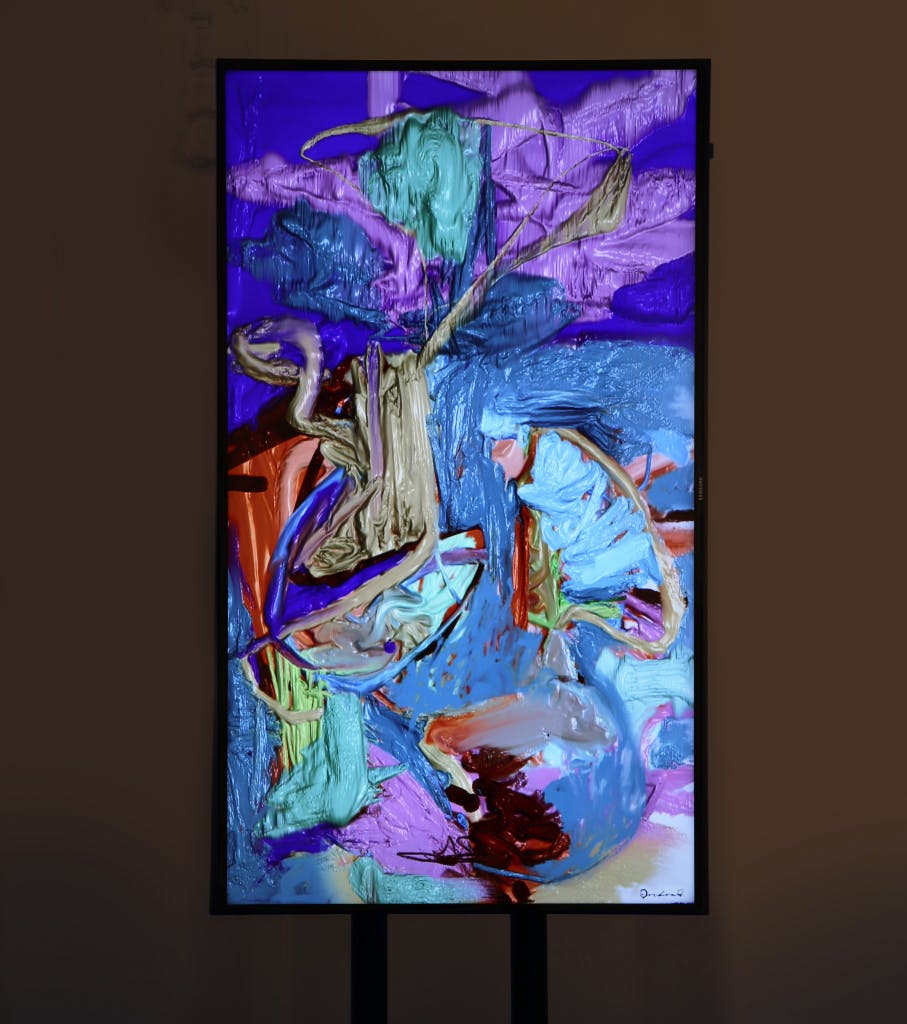
Q: Who or what inspired you to become an artist?
A: Since I was really young, I had this primal instinct to create something. When I was three years old, I made a series of around twenty-five portraits in two days and I remember being so fascinated by the creative process. It’s something that I always had and was drawn to. In my family nobody has anything to do with art, they’re not artists so usually the only paintings hanging in my house growing up were created by me.
At first it was just me doing something that I liked and slowly developing that passion, but then I discovered and started reading about art history, and this changed everything.
I suddenly became aware of the historic context for art, and I realized It is an important part in every society’s culture and our expression as a human race. This really inspired me and I realized that I wanted to become part of that conversation. My aim is to express the times we live in through art and hopefully I could contribute something to it.
Q: Thank you for sharing your words and art into this space, it’s very much needed. Thank you.
Links:
Blockchain Artwork Series: https://www.gordonberger.com/
SuperRare Profile: https://superrare.com/gordon_berger
‘Materiality’ & ‘Solidity’ Video Explanation: https://www.youtube.com/watch?v=sWUa6Jn_Veo
TEDx Talk: https://www.youtube.com/watch?v=QlgE_mmbRDk
Instagram: https://www.instagram.com/gordon.berger.art