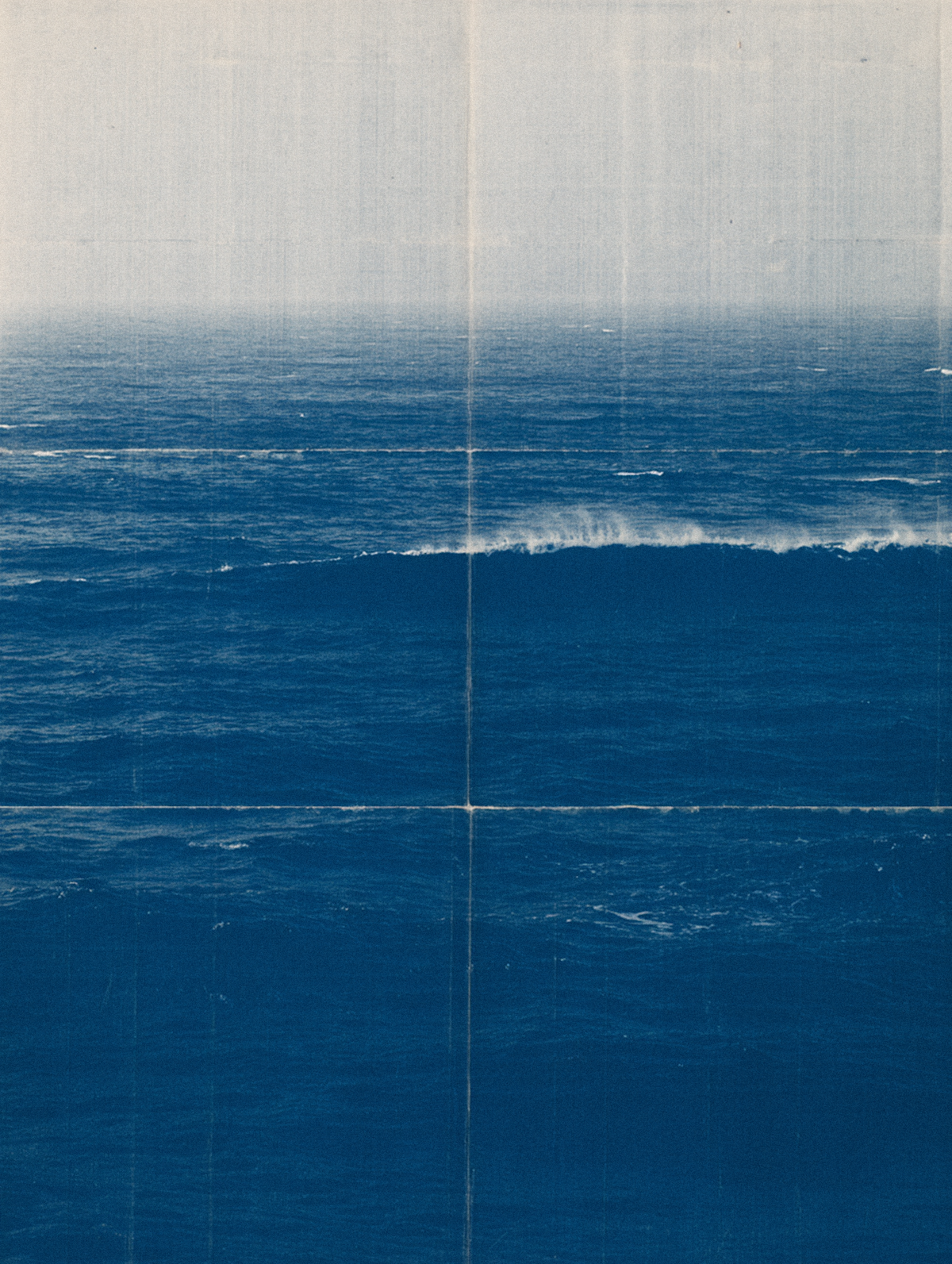
Paper is a fragile carrier of human memory. We preserve letters, photographs, drawings and accidental traces as material evidence of the past, often returning to them when memory becomes unreliable.
But paper does not preserve information unchanged. It folds, tears, fades, absorbs moisture and paint, and accumulates new traces.
The sea appears throughout the series as a recurring image of distance and remembered place, preserved through photographs, printed images and personal recollection. It becomes a landscape that can be carried, revisited and gradually transformed through the material that holds it.
Latent Cellulose treats paper not simply as a surface, but as a structure in which information accumulates and transforms.
The title refers directly to the latent space of AI models, where visual features and relationships are encoded. Cellulose becomes its physical counterpart: an invisible material structure that determines how paper folds, absorbs, tears, fades and retains traces.
AI introduces another layer of reconstruction. Rather than restoring a lost original, it generates new visual relationships from patterns encoded within its latent space.