Plein Air Painters - The Aristocracy of Ruin
Post-painting
Circa 2026
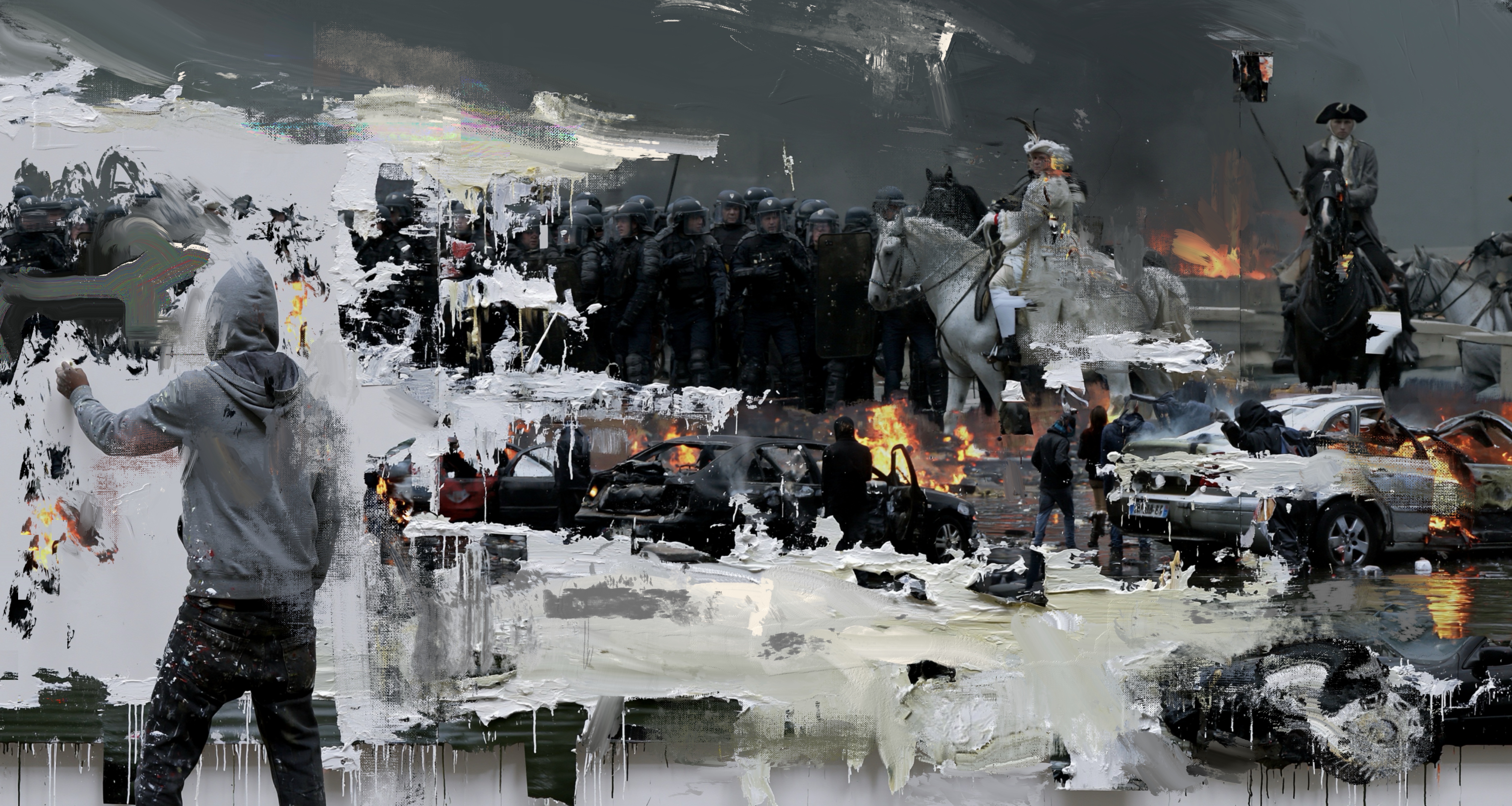
In The Aristocracy of Ruin, the traditions of European painting are subjected to a spectacular act of historical and visual disobedience. Young artists work at monumental canvases amid a surreal collision of aristocratic pageantry, burning vehicles and urban disorder. Powdered wigs and ceremonial authority coexist with the debris of modern civilisation, while violent passages of crimson, yellow and black threaten to consume the image itself.
The absurdity is deliberate. Centuries of social hierarchy are compressed into a single impossible moment, where the aristocracy becomes an anachronism and the painters emerge as the only figures meaningfully engaged with their surroundings. The landscape, once the romantic preserve of plein air painting, is transformed into a theatre of political contradiction and existential uncertainty.
Central to the work is its exploration of post-painting, in which the boundaries between traditional painterly expression, artificial intelligence and digital construction are fundamentally reconsidered. Rather than treating technology as a substitute for artistic authorship, the work positions it within an expanded painting practice, allowing disparate histories, visual languages and imagined realities to occupy the same pictorial space. The resulting image is neither a record of an event nor a conventional depiction of fantasy, but a constructed reality that questions the very conditions under which images acquire meaning and authority.
There is a compelling self-referential quality to the composition: painters painting within a painting, surrounded by a world seemingly incapable of distinguishing its own history from its impending collapse. Their enormous canvases become both subjects and interventions, asserting the continuing relevance of painting in an age increasingly dominated by manufactured images.
Ultimately, The Aristocracy of Ruin proposes that painting's importance lies not in faithfully representing the world, but in its capacity to dismantle and reconstruct it. Here, post-painting becomes an act of cultural resistance, confronting the absurdities of power, the instability of history and the uneasy relationship between human imagination and technological invention.