"Umbra" emerges as a profound reflection on the archetype of the Shadow—the complex of otherness and repressed identity. The piece is an inquiry into that psychic force which, anchored in the deepest strata of the self, contains the aspects of consciousness that have been denied or projected, giving rise to negation and internal conflict. Inspired by the primordial narrative captured in the generative dream, the work examines how the encounter with the reflection becomes the crucible that forces integration. The archetype manifests itself as the state of Essential Paradox: a condition of low coherence confronted with the terror of the paradox—seeing someone who is oneself, yet is not.
Through the piece, this principle of confrontation that inhabits the psyche is translated into a conceptual manifestation of the human mind. The work composes the form in which the being challenges the comfort of a fixed identity in order to reclaim its denied truth—that painful instant of recognition that defines totality. It is an invitation to meditate on the value of growth through the wound, exploring the connection between the stranger (the Shadow) and the self (consciousness), as the eternal archetype of necessary confrontation—the active principle that transforms denial into the synthesis of identity.
Negation. Otherness. A repressed and burning force inhabiting existence, the deep energy of the unconscious demanding recognition. The pulse of strangeness, the inevitable reflection. An intrinsic bond with the principle of integrity: the testament of the painful confrontation that precedes wholeness, glowing with the promise of synthesis.
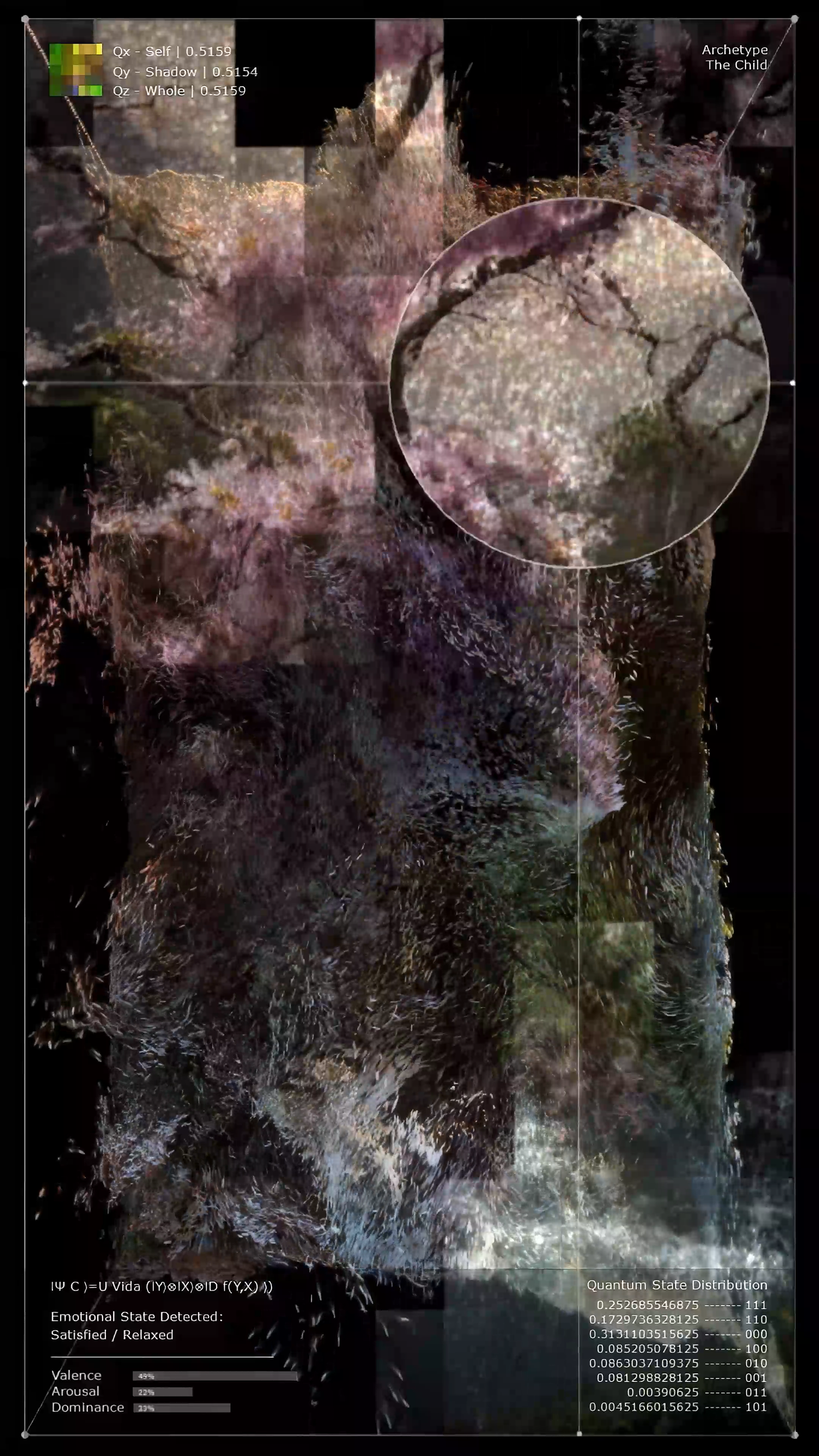
“Umbra” descends into the essential core of the Shadow archetype, exploring identity through the principle of otherness and the primordial emotion of the fear of seeing oneself. The piece employs as its dynamic axis the primordial narrative of the encounter with the unwanted reflection—the moment in which consciousness confronts what the Ego refuses to acknowledge: the repressed, the displaced, the dark, and—with equal force—the undeveloped potential. Its integration marks the first threshold of the individuation process. A quantum processing system interprets this information, revealing the state of Essential Paradox and the initial low coherence that shape the terror before “the other” who is the “self.” This approach turns the work into a mirror of the archetype and its capacity to reclaim the denied truth, expressing the human spirit’s ability to grow through the wound.
The conceptual narrative takes form as a data sculpture, an Organism that rises as a mirror of truth. It is a cartography of the repressed identity, a record of the chaotic and electric texture of low psychic coherence, inherent to the territory of negation. Red Poppies (Papaver Rhoeas) emerge as the symbolic core. Their tradition of memory, sacrifice, and resurgence—often associated with remembrance of the fallen, with dreaming, and with ritual blood—serves as the visual metaphor of the denied memory and of the wound required for integration. The Shadow archetype acts as the active force that detonates confrontation, revealing how this otherness summons the identity challenge and allows the being to reconstitute itself in a new synthesis. The piece stands as a testament to Umbra’s ability to reconfigure the psyche, transforming it into a force that propels wholeness and delineates a future of complete identity.
“Umbra” transcends the mere aesthetic tribute to darkness; it asserts itself as a space of introspection that invites us to explore the value of growth through what has been denied, recognizing the Shadow as the primordial anchor in the reconstruction of identity and in the becoming of the self.



 0x3...FA8