Full Size
The Arcade War Machine
The Arcade War Machine
Post painting
Circa 2026
Harman’s process moves between analogue gesture, AI interference, and digital painting, where the hand resists, the machine predicts, and authorship fractures in between. Using his analogue oil painting skills, he smears, reduces, and builds texture, collapsing form into something unstable, something that feels both remembered and corrupted. What emerges is not synthesis, but tension, an image caught between human intention and systemic production.
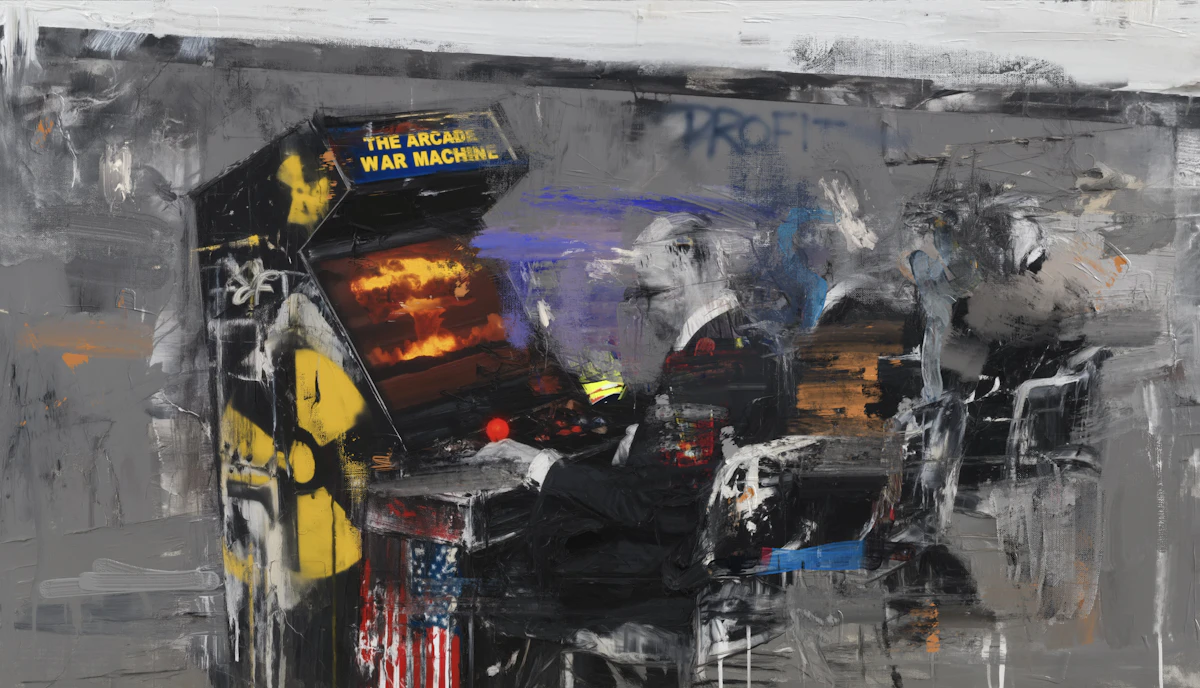
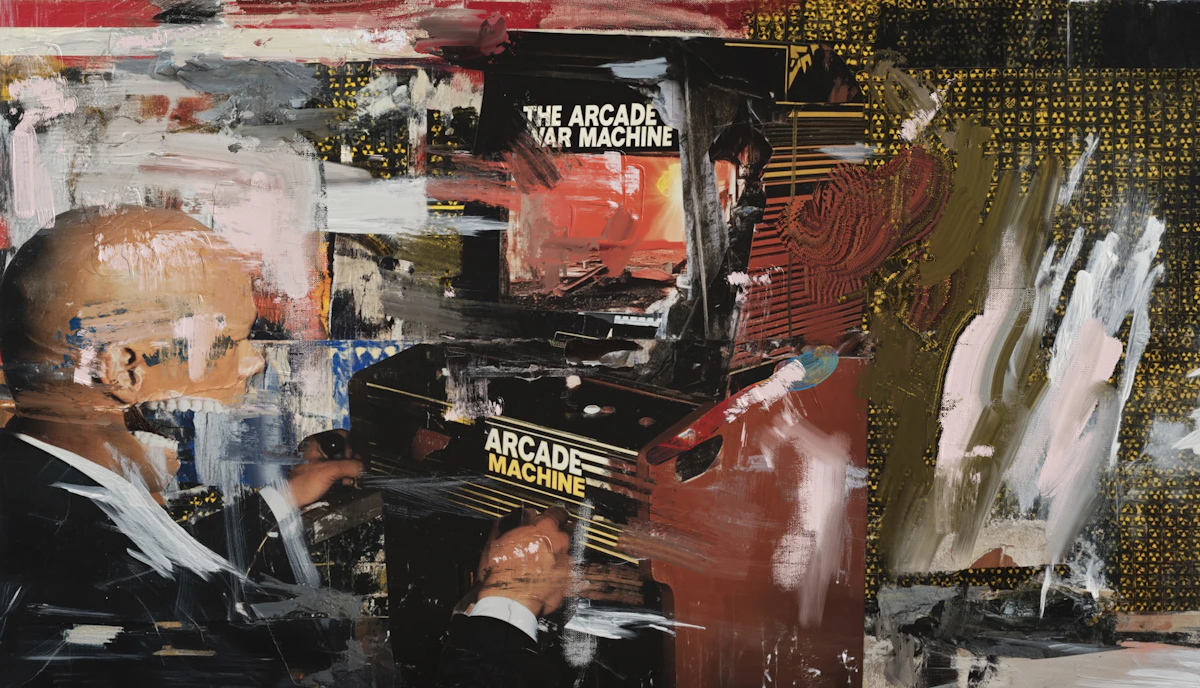
Within The Arcade War Machine, the figures that populate these paintings are not individuals in any traditional sense, but apparitions of power, ghouls in suits, hollowed-out operators of late-stage geopolitics. They resemble executives, policymakers, neocons, but stripped of clarity or identity, reduced to silhouettes, skull-like forms, or smeared presences. They do not act so much as persist, lingering within systems they neither fully control nor escape.
Their relationship to the arcade cabinet is ritualistic. They sit, stand, gather, transfixed by its glow, as though engaged in an act of devotion rather than play. The cabinet is no longer an object of entertainment, but a terminal, a command interface, a site where abstraction replaces consequence. The mushroom cloud flickers endlessly on the screen, not as catastrophe, but as image, looped, flattened, consumed.
The environments shift between interior and exterior, yet offer no real distinction. Some scenes unfold within bunker-like concrete shelters, sealed, oppressive, suggestive of containment, secrecy, and institutional control. Others appear exposed, desolate outdoor spaces, fractured urban edges, wastelands marked by radiation symbols and collapse. Yet both feel equally enclosed. There is no true outside, only different conditions of the same system.
In this world, the geopolitical landscape is not represented, but internalised. War is no longer distant, it is ambient, embedded into the fabric of perception. The arcade becomes its perfect metaphor, a closed loop of input and response, where complexity is reduced to interaction, and participation replaces understanding.
The figures, these ghouls of governance, continue to play. Not out of necessity, but because the system requires it. Because there is no alternative offered. Because the game does not end.
Painting, here, becomes a site of resistance and complicity at once. The analogue mark insists on presence, on the trace of the human, while AI and digital processes dissolve that certainty, introducing repetition, distortion, and inevitability. The image flickers between control and surrender, much like the world it reflects.
The Arcade War Machine does not offer resolution, nor critique from a distance. It operates from within the loop, exposing a condition where power is abstracted, violence is aestheticised, and the human figure is slowly absorbed into the machinery it once believed it controlled.
- MediumImage (JPEG)
- File Size8.0 MB
- Dimensions7500 x 4300
- Contract Address
- Token StandardERC-721
- BlockchainEthereum