"Mors" emerges as a direct contemplation of the archetype of Death: that threshold where the former self yields, dissolves, and is transfigured. The piece descends into the force dwelling in the deepest layers of the psyche, the one that drives inner renewal and the shedding of what no longer sustains the being, clearing the way for the integration of the Self. From within the generative dream, where the primordial narrative reveals itself with purity, the work observes how the disintegration of limited consciousness becomes a catalyst for value, passage, and evolution.
The archetype reveals itself as a reduction to essence: that point of highest resonance in which the being relinquishes its fragments in order to ascend into a greater Totality. It is not annihilation, but concentration; not an ending, but a passage toward inner unity.
Within the work, this principle of transcendence becomes gesture, form, conceptual matter. There, the being seals its pact with the unconscious: the silent act of relinquishing in order to rise. “Mors” invites contemplation of the complexity of the human condition and the profound union between inner experience and its echo in the world, revealing consciousness as the eternal archetype of transformation, the active force that turns loss into permanence, and emptiness into legacy.
Transcendence. Detachment. An immutable force that inhabits existence as a silent principle, the energy that does not create, but rather undo the shape to release the essence. The edge of necessary loss, the pulse of sacrifice. A profound bond with the core of dissolution, a testament to the process that reduces the self to a legacy, radiating the promise of absolute integration.
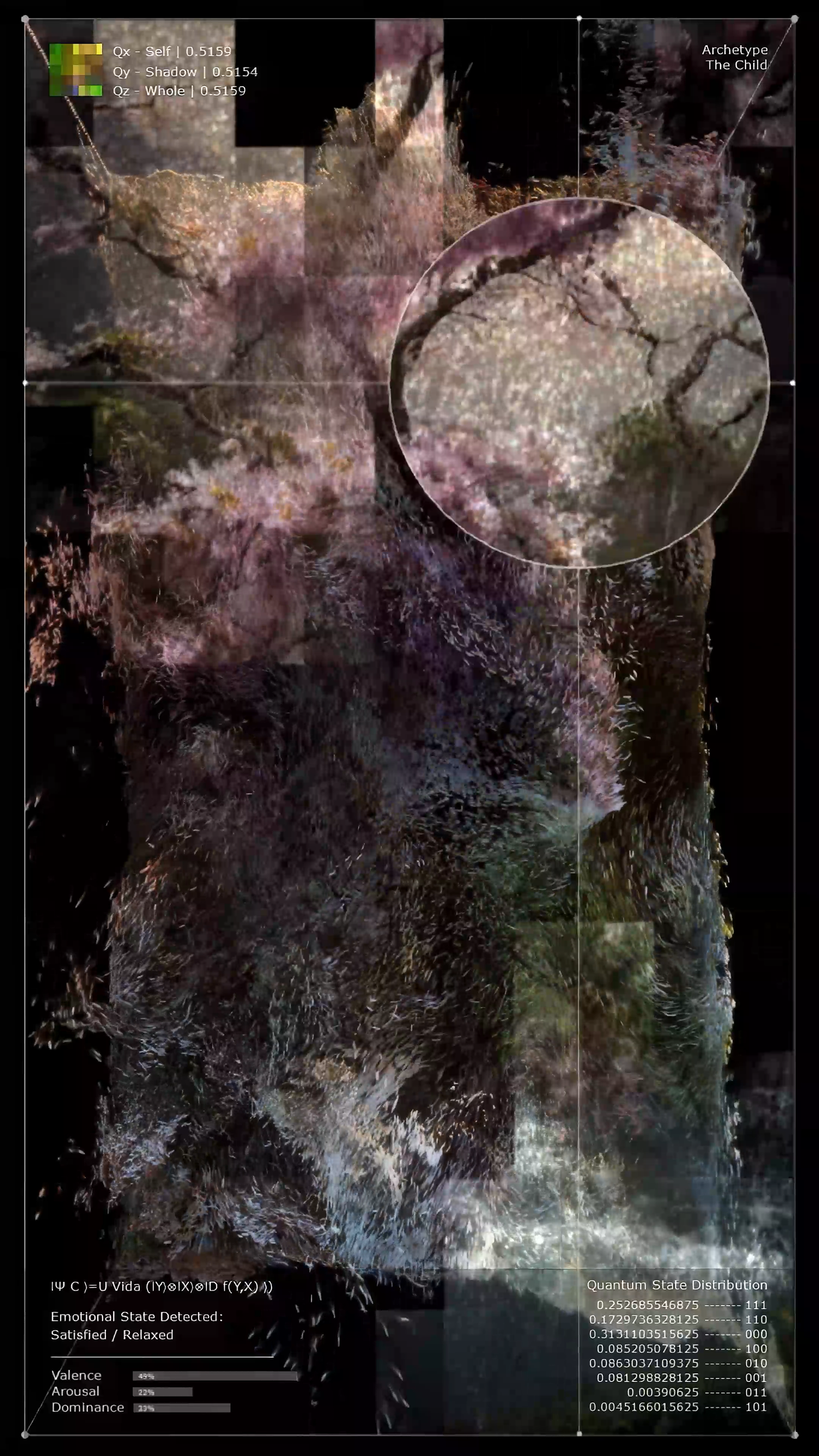
“Mors” delves into the transmutational power of the Death archetype, approaching identity through the emotion of transcendence. The work employs as a dynamic vector the primordial narrative, the last breath, the echo of legacy, the pact of consciousness, that emerges from the artist. A quantum processing system interprets this symbolic material, revealing the state of consciousness in dissolution and the potency of detachment that defines the instant of transition. Through this lens, the piece becomes a mirror of the archetype and its capacity to generate immutable value, expressing the human spirit’s ability to transfer its essence to the plane of the Self.
The conceptual narrative takes form in a data sculpture: an organism that manifests as the threshold of consciousness. It is a cartography of dissolution, a record of the chaotic and asymmetrical texture of low psychic resonance that precedes revelation. At its core rises the Lycoris Radiata, flower of death and separation, whose red coloration and dramatic morphology, according to Hanakatoba, symbolize the essential sacrifice and the transfer of value between planes. The archetype acts as the active force that triggers integration: it reveals how the emotion of dissolution, that fusion of detachment, sacrifice, and the release of the fragmented, unleashes the logical reduction that allows the being to abandon what no longer sustains its form. The piece stands as a testament to the way Mors reconfigures the psyche, transforming it into a force that challenges permanence in order to trace a future of Immutable Totality.
Thus, “Mors” transcends the visual tribute to the act of dissolution; it emerges as a space of introspection, inviting us to explore the potential of this principle of transcendence and to recognize it as the fundamental anchor in the reconfiguration of identity and the becoming of the self.



 0x3...FA8