“And there went out another horse that was red: and power was given to him that sat thereon to take peace from the earth, and that they should kill one another: and there was given unto him a great sword.” — Revelation, Chapter 6, Verse 4
THE RECKONING OF THE SECOND SEAL: THE ASCENT OF THE FIRE-BEARER
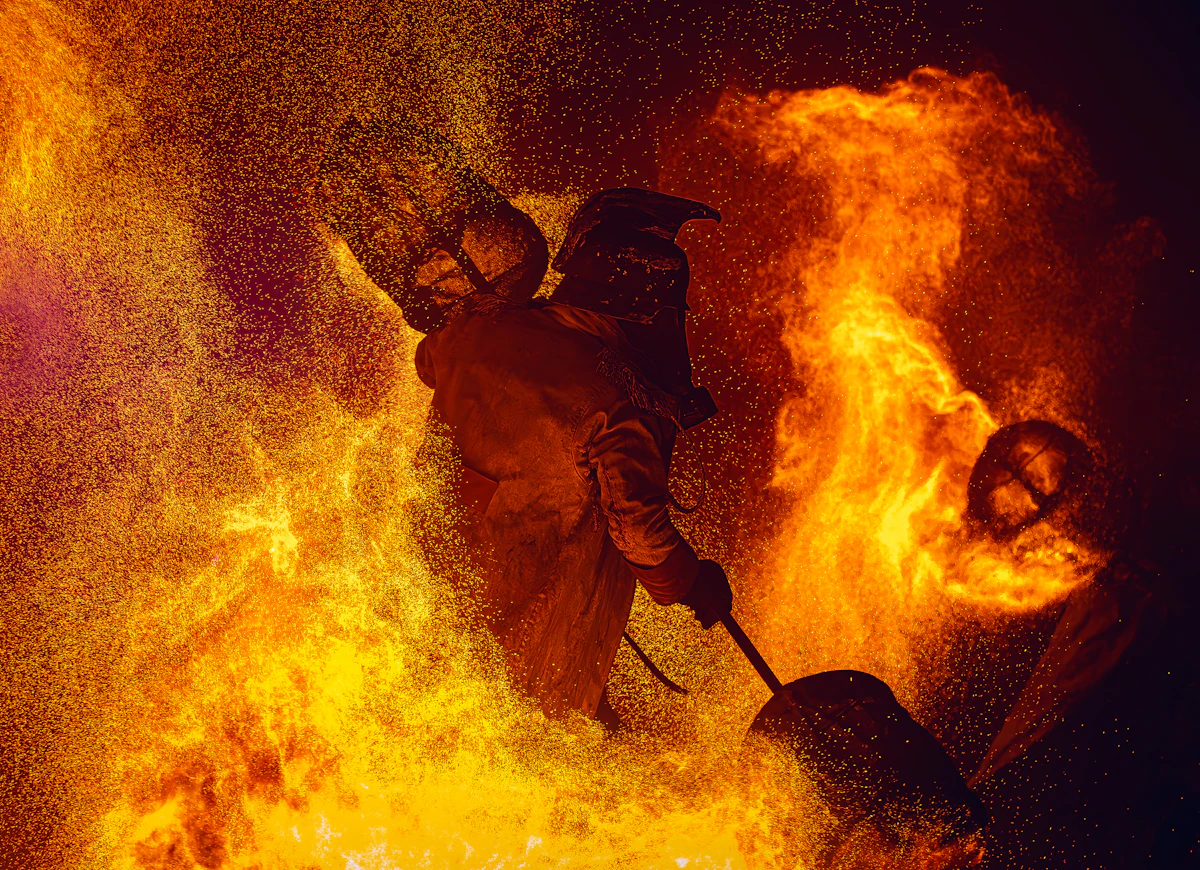
The silent decay of the first contagion was merely the turning of the page. Where the tyrant-ruler of Pestilence completed his grim occupation, the compromised roots of the empire could no longer hold the shifting weight of the earth. From the split, blackened soil where the ancient forests meet the crumbling watchtowers of forgotten dynasties, the second seal cracks wide open. He emerges without a beast, stepping directly out of a blinding furnace of roaring, unyielding flame. The dawn did not break; the sky simply caught fire.
This is the great, inescapable Reckoning — a cosmic hour of ledger-balancing where nature withdraws her mercy from a world blinded by its own greed and vanity. In place of the biblical blade, He carries an archaic, brutal flamberge, its wave-like steel undulating like a frozen tongue of wildfire, a weapon forged to inflict deep, lacerating wounds. Equally terrifying is his ancient helm, adorned with the crested ridge of a fierce dragon. He is the materialization of absolute cosmic anger, an indifference so deep it burns the stone.
War. War never changes. Since the dawn of human tribes, when the first nations raised stone fortresses against the night and each other, blood has been spilled in the name of pride, gold, and gods. Even in the final days of the fading empire, the reasons remained the same, born of the oldest human sin: too many ambitions, and too few lands to contain them. But when the second seal broke, the petty squabbles of mortal lords were silenced by a terrifying, total finality. For when the flame rises, it matters not who held the crown, nor who possessed the gold and land.
The destruction He brought upon the realm was a furious, irreversible tragedy of clashing steel and black ash. The proud chivalry of the kingdom — knights in fluted plate and grand lords bearing ancient great swords — rode out in desperate, futile legions to block his march. Their steel, forged over generations of honorable masters, shattered like cheap glass against his burning vanguard. There were no songs of glory left; the heavy cavalry died in stone valleys where the heat melted even the rivets of their armor, welding bones to stirrups. The great stone fortresses collapsed inward as their deep pine beams turned to weeping charcoal, burying whole lineages beneath a monument of soot. Only the proud red shield, shattered and splintered at his feet, remained as the final trophy of a slaughtered vanguard, its archaic crest erased by the blinding heat.
Could this apocalyptic cascade have been prevented? Was there a single turning point where the lords of men could have averted this ash? The painful and devastating truth is absolute: no. This mutual total annihilation, this insatiable hunger to turn the blade upon one another, is not an external curse but the primary, unalterable defect of the human design. It is an ineradicable flaw deeply hardcoded into the species' primordial software — a fatal loop that humanity, blinded by its own arrogance, inevitably executes century after century. War is the species' own auto-immune cleansing mechanism, a terrifying wheel of an irreversible destiny where mankind violently purges itself of itself, only to reset the clock until vanity ripens once more. The grand architecture did not fall to an invading god; it was broken from within, driven by the inescapable system failure of its own creators.
He stands motionless amidst the black, calcified ruins of the gatehouse, a silent sentinel of smoke watching the slow, irreversible cremation of everything that once claimed to be eternal. The second domino has fallen into the ash. The Fire-Bearer has claimed his silent throne amidst the absolute conflagration of war.
But as the blistering heat waves warp the very air of the dead southern valleys, the crackle of the burning timber carries a deeper, shifting vibration through the soot: He is merely the second note of the apocalyptic symphony. The smell of burning sulfur is already yielding to a terrifying, absolute absence of sound. The wind is dying. The soil is turning cold and dry. He is not alone. The others are coming.
(Fine Art Photography. Created in October 2026).